07 · Signs
Signs, markings, and who goes first
Published · Updated · About 16 minutes of reading
Bulgaria uses the European sign system: shapes first, then the symbol, then any plate underneath. The drawings on this page are memory aids made for the article. They are not the regulated artwork, and they are not a set you can treat as complete.
-
1
A person directing traffic
If an officer’s signal and a light disagree, follow the officer. The same is true against a sign.
-
2
A portable sign in the carriageway
A sign on a stand in the road overrides the fixed signs around it. Works use this constantly.
-
3
The light signal
When a light and a fixed sign disagree about priority, follow the light.
-
4
The fixed traffic sign
When a sign and a road marking disagree, follow the sign.
-
5
The marking
Arrows, stop lines, and lane lines apply when nothing above them has said otherwise. Temporary markings during works replace the old pattern.
Shapes, read before the words
You will not always read a plate in time. The silhouette is the message. Plates in Bulgaria may be in Cyrillic. A place name you cannot read is a reason to slow down, not a reason to ignore the shape.
-
Warning
A triangle point-up. Junctions, bends, crossings, animals, works. It does not by itself set a speed. It tells you the hazard is ahead.
-
Give way
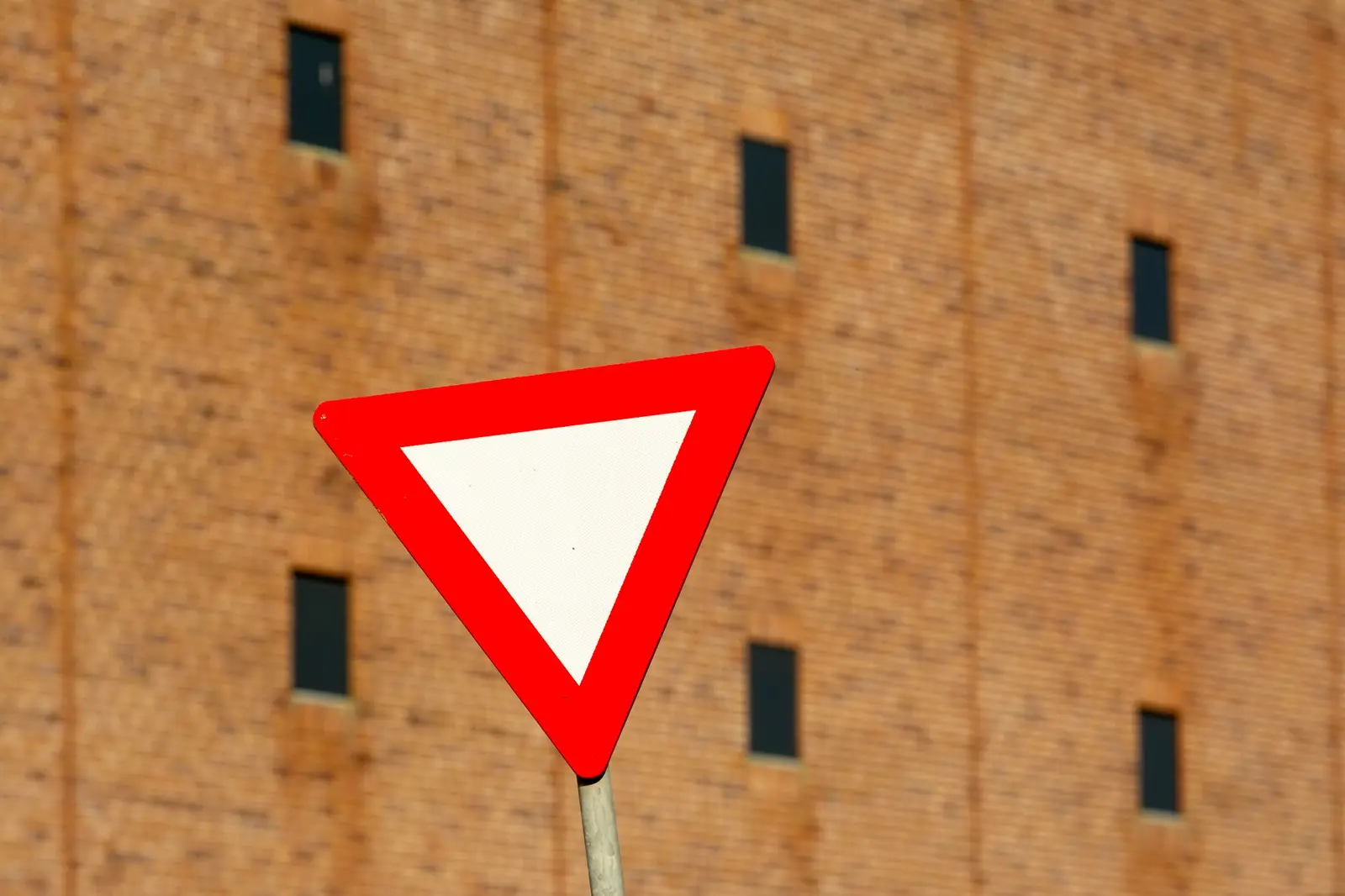
A triangle point-down, red border. Yield. You do not have priority. The stop sign is the octagon, a full stop, not a rolling one.
-
Priority road
A yellow diamond with a white rim. You are on the priority road until the same diamond appears cancelled. End of priority is the diamond with a black bar.
-
Prohibition
A red ring. No entry, no overtaking, a weight limit, a speed limit. A number inside a red ring is a maximum, not a target.
-
Obligation
A blue disc. Direction you must take, or a path you must use. Blue is not a suggestion in this family.
-
Direction
Rectangular panels. On a Bulgarian motorway these direction panels are green. Other roads use blue panels. The colour is a clue to the class of road, which is why a blue German motorway sign in a photograph is not a lesson about Bulgaria.
The sign that changes your speed
A built-up area begins and ends with place-name signs. Inside, the general limit for almost every motor vehicle is 50 km/h unless another sign sets something else. Outside, a car returns to 90 unless the road is signed as express or motorway. People miss this when the buildings thin out before the end-of-town sign, or when the town sign is still up beside a road that feels rural.
Motorway start and motorway end are their own signs. Between them, a car’s general limit is 140. After the end sign, it is not. Express roads have their own start and end, and 120 for a car. The numbers, and the lower ones for motorcycles and lorries, are in the car guide.
Markings and works
White lines divide lanes and show edges. A stop line belongs with a stop sign or a light. Arrows in the lane are mandatory for the direction they show. Yellow or temporary markings during works are the ones to follow when they replace the permanent paint.
Do not overtake when the line forbids it, when you cannot see, or when the vehicle ahead hides a crossing. Pedestrians on a crossing have priority, including a person at the kerb who has signalled the intention to cross. Details sit in the driving pages: motorcycles have the same signs and a lower speed table.
If a sign and this page disagree, the sign is right. A schematic triangle is not a defence. The disclaimer says the same thing in plainer legal language. For a route that depends on these signs, see planning a drive.